


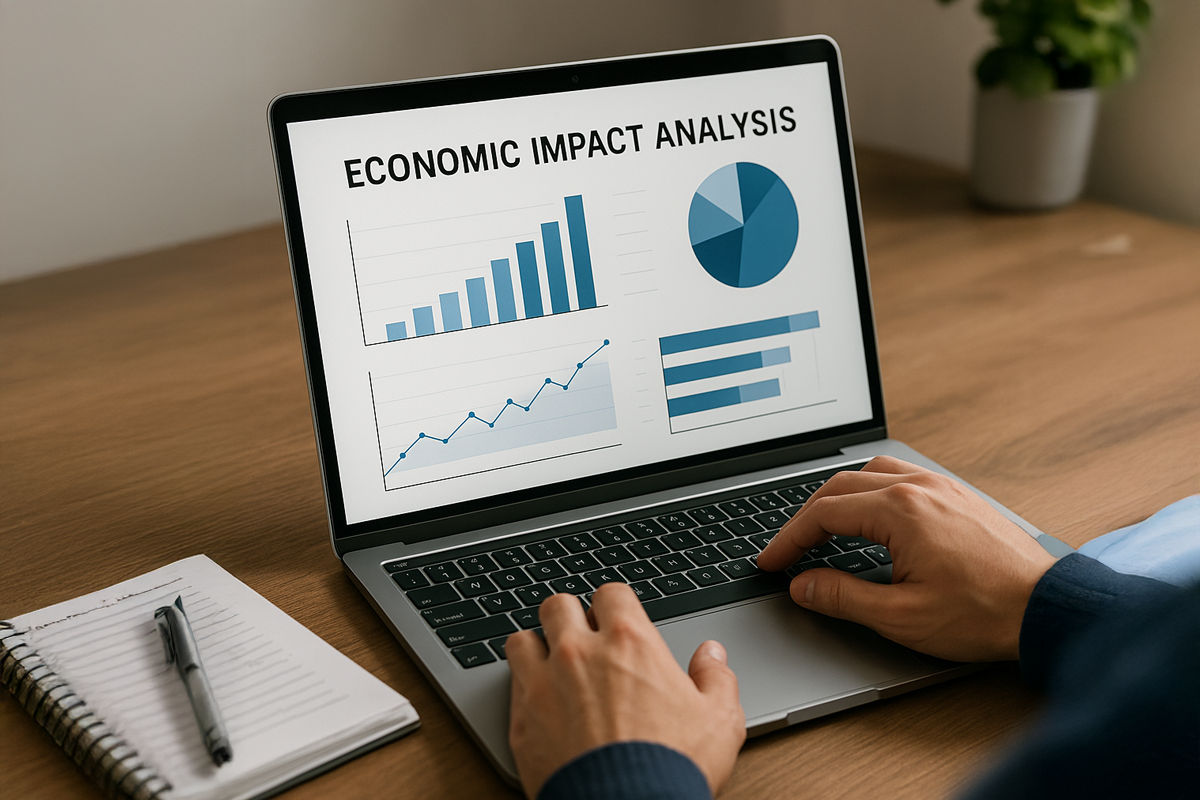
Economic Impact Assessments serve as a foundational tool for government agencies, urban planners, and private developers. By providing a structured, quantitative analysis of how a specific project, policy, or event influences a regional economy, these assessments act as a bridge between abstract data and concrete decision-making. At its core, an Economic Impact Assessment attempts to answer a fundamental question: how does the injection of capital or a change in policy alter the financial landscape of a specific geography?
Whether it is the construction of a new manufacturing plant, the introduction of a tax incentive, or the hosting of a massive cultural festival, every significant undertaking creates a ripple effect. This ripple moves through the local, state, or national economy, touching businesses, households, and government coffers. Understanding these dynamics is essential for ensuring that investments yield intended benefits while minimizing unintended negative consequences.
The Three Tiers of Economic Impact
To accurately gauge the influence of an initiative, analysts categorize the outcomes into three distinct waves of economic activity. These tiers provide a holistic view of how money flows through a community.
Direct Effects
These represent the immediate outcomes of the initial expenditure. If a company builds a new corporate headquarters, the direct effects include the hiring of construction crews, the purchase of steel and concrete, and the subsequent employment of the administrative staff that will occupy the building. These effects are the easiest to measure because they are directly tied to the primary project budget and employment records.
Indirect Effects
Often called the supply chain ripple, these effects occur when the businesses involved in the direct phase make purchases from their own vendors. Using the headquarters example, the construction firm might hire local plumbers, electricians, and specialized engineers. These firms, in turn, purchase supplies, lease equipment, and hire support staff to fulfill their contracts. The economic activity is one step removed from the initial investment but is a vital component of the overall regional gain.
Induced Effects
The final wave is generated by the household spending of employees. When individuals are hired for the construction or operation of a project, they earn wages. That income is then spent on local goods and services—groceries, housing, utilities, and entertainment. This consumer spending fuels retail and service industries, effectively extending the economic impact into the broader community.
Methodologies and Data Collection
Performing a rigorous assessment requires more than just guesswork; it demands a systematic approach to data gathering and modeling. Analysts typically employ one or more of several established techniques to arrive at their findings.
-
Input-Output Modeling: This is the most common method. It uses mathematical tables to track the flow of goods and services between different industries in an economy. By understanding these interdependencies, analysts can apply multipliers to direct spending to estimate the total ripple effect.
-
Computable General Equilibrium Models: These are more complex and sophisticated tools that look at how markets interact. Unlike basic input-output models, they account for constraints such as labor shortages or price changes, providing a more dynamic view of how an economy reacts to major shocks.
-
Survey-Based Research: For localized projects, such as events or tourism initiatives, analysts often collect primary data. This involves surveying attendees or local business owners to understand exactly how much money is being injected into the local economy versus how much is leaking out to external vendors.
A significant challenge in this process is identifying leakage. If a project is built using materials sourced entirely from outside the region or if the labor force consists of non-residents who take their earnings home, the actual local economic benefit is significantly diluted. Accurate assessments must account for these factors to avoid overestimating the net gain to the community.
Why Decision Makers Prioritize These Assessments
The primary value of these assessments lies in their ability to inform, justify, and refine policy. In an era where public and private funds are under intense scrutiny, stakeholders require evidence that their resources are being deployed efficiently.
Justifying Public Investment
When a city considers providing tax breaks or infrastructure support for a development project, they must ensure the public receives a return on that investment. An assessment provides the quantitative data needed to demonstrate that the project will generate sufficient tax revenue, job creation, or long-term growth to warrant the initial cost.
Mitigating Risks and Unintended Consequences
Assessments are not merely for boasting about projected benefits; they are essential for risk management. They help identify if a project might place unsustainable pressure on local infrastructure, such as roads, housing, or social services. By flagging these potential issues early, policymakers can implement mitigation strategies, such as zoning adjustments or investment in public transport, to ensure the project remains sustainable.
Enhancing Transparency
For large-scale projects that face public opposition, an independent assessment can be a powerful tool for clarity. It demystifies the economic claims made by proponents and detractors alike, offering a neutral, fact-based baseline that can facilitate more productive public discourse.
Limitations and Ethical Considerations
While these studies are invaluable, they are not infallible. Critics often point to the potential for multiplier abuse, where analysts use overly optimistic assumptions to inflate the projected benefits of a project. Furthermore, traditional assessments often struggle to account for the opportunity cost. For example, if a city gives a land grant to a factory, that land is no longer available for a park, a school, or a different type of commercial development.
Moreover, economic growth is not the only metric that matters. An initiative might show a massive boost in Gross Regional Product but simultaneously decrease the quality of life due to pollution, traffic congestion, or rising housing costs that price out current residents. Future-forward assessments are increasingly shifting toward integrating social and environmental metrics to create a more balanced, multi-dimensional view of impact.
The Role of Temporal Scope in Assessments
When conducting an assessment, the time horizon is a critical variable that often gets overlooked. A project might provide a massive stimulus during the construction phase, but the long-term operational impact might be modest. Conversely, an investment in education or digital infrastructure might show negligible short-term effects but yield transformative results over a decade. Analysts must clearly define whether they are measuring one-time events or recurring annual benefits. By segmenting the impact by time, stakeholders can better understand the alignment between the project and the short-term or long-term goals of the region. This temporal segmentation helps in setting realistic expectations for the public and private partners involved.
Integrating Qualitative Factors
Quantitative data forms the backbone of these assessments, but qualitative factors are equally important for comprehensive decision-making. These might include the enhancement of the city brand, the fostering of community pride, or the improvement of the area as a destination for talent attraction. While difficult to assign a dollar figure to these elements, they often contribute to the long-term economic vitality of a region. An assessment that ignores these “soft” impacts may fail to capture the full narrative of a project’s worth. Therefore, leading analysts are now including qualitative addendums that explain how a project influences the intangible yet critical factors that make an economy resilient and competitive in the global market.
Frequently Asked Questions
1. How does an Economic Impact Assessment differ from a Cost-Benefit Analysis?
An Economic Impact Assessment focuses on the change in economic activity—such as jobs and income—within a specific region. A Cost-Benefit Analysis, by contrast, compares the total societal costs of a project against its total benefits to determine if it is a net positive for society, regardless of where those impacts occur.
2. Can an Economic Impact Assessment predict negative impacts?
Yes. While often used to highlight growth, a high-quality assessment identifies potential negative outcomes such as inflation of local prices, strain on public infrastructure, or the displacement of existing local businesses.
3. What is the role of multipliers in these studies?
Multipliers are numerical factors that estimate how one dollar of initial spending creates additional economic activity as it changes hands through the local supply chain and household consumption.
4. Why is geographical definition important in these assessments?
The boundary of the study (e.g., a city versus a state) dictates what counts as local spending. If the boundary is too large, the assessment might capture spending that is actually leaving the local area, leading to an inaccurate reflection of local benefits.
5. How do analysts account for jobs that are only temporary?
Analysts typically distinguish between construction-phase jobs, which are temporary, and operational-phase jobs, which are permanent. Both are reported, but they are weighted differently because they have different long-term effects on the community.
6. Is it possible for a project to have a high economic impact but low social value?
Yes. A project might generate significant revenue and jobs but fail to improve community well-being or even harm the environment, which is why integrated assessments that include social and environmental factors are increasingly preferred.
7. Who typically commissions these reports?
These reports are usually commissioned by local governments, regional development agencies, private corporations seeking permits, or community groups wanting to better understand the potential effects of a proposed development in their area.








Comments are closed